
Let me tell this client's story: Telegram had quietly become one of the company’s most active support channels.
Customers were sending messages inside dedicated groups. Issues were discussed in real time. The team responded quickly. Conversations moved fast.
From the outside, support looked agile.
From the inside, it was invisible.
None of those conversations were structured inside HubSpot. No tickets, no conversations, nothing in the records. No SLA clocks were running. No reporting existed on response time, workload, or volume by channel.
The team didn’t have a communication problem.
They had a visibility problem.
And visibility is what enables management.
The Risk of Invisible Support
When customer conversations live outside your CRM, leadership loses control over three critical levers:
- Performance — You cannot measure response time or SLA compliance.
- Accountability — You cannot see who owns what.
- Insight — You cannot analyze recurring issues or support trends.
At first, this seems manageable. A growing company can tolerate informal processes.
But scale exposes fragility.
As ticket volume increases, as customers expect faster responses, and as leadership demands metrics, the absence of structure becomes a bottleneck.
Telegram was efficient for communication.
But it wasn’t operational.
Why a Standard Integration Wasn’t Enough
An external provider had already proposed a solution. Technically, it connected Telegram to HubSpot.
But Telegram messages appeared under contact records instead of creating Help Desk tickets.
On paper, that is integration.
In practice, it’s misalignment.
Support workflows are built around tickets — not contact timelines. SLAs attach to tickets. Routing happens through tickets. Reporting relies on ticket pipelines.
If Telegram messages don’t generate tickets, they remain operationally disconnected from the system that manages support performance.
The question wasn’t whether Telegram could connect to HubSpot.
The question was whether Telegram could become a first-class support channel.
The Strategic Objective
The leadership requirement was clear: Telegram must behave like any other official support channel.
That means:
- A message triggers a ticket.
- The ticket enters the Support pipeline.
- SLAs begin automatically.
- Ownership is assigned.
- The conversation remains open until formally closed.
- Reporting includes Telegram alongside email and other channels.
Customers should not experience any friction.
Internally, everything should become measurable.
The Architecture: Structure Without Friction
The solution was intentionally simple from the user’s perspective.
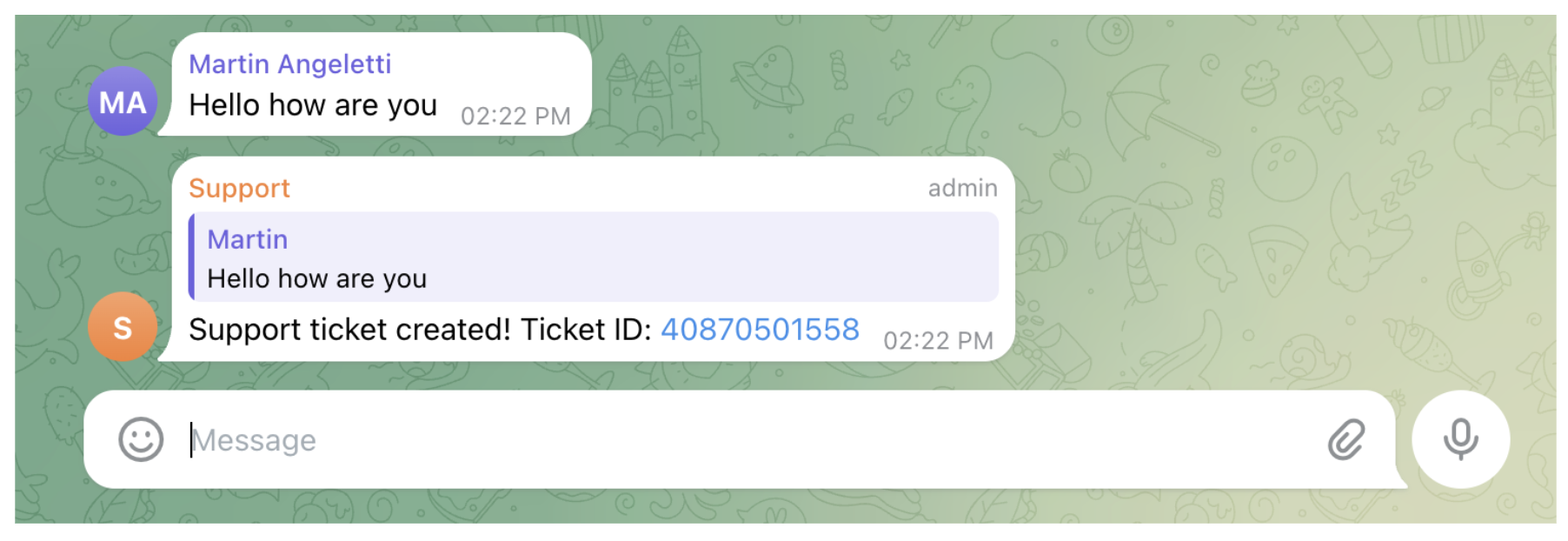
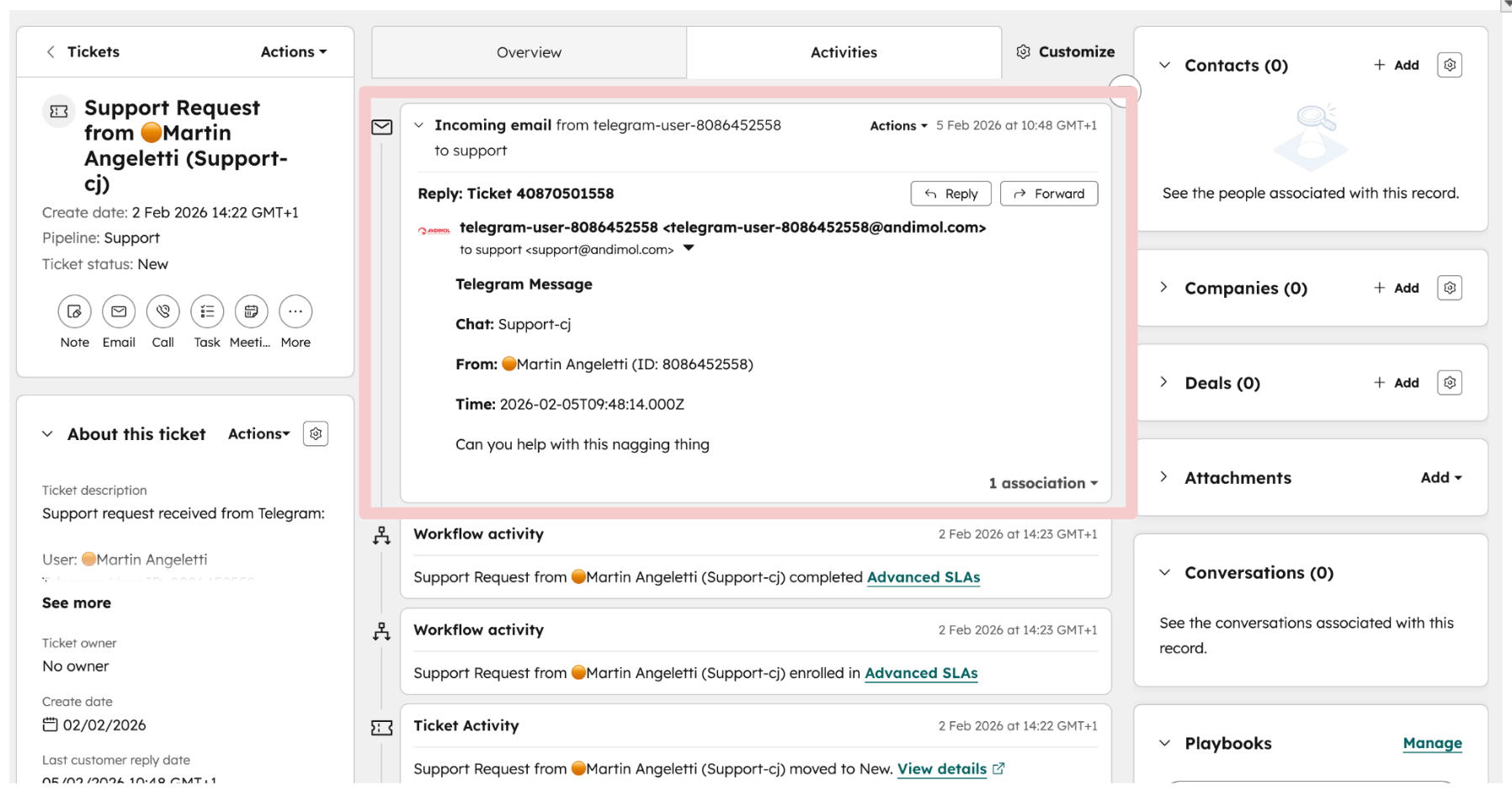
A Telegram bot listens to specific support groups. When a message is sent, the bot automatically confirms receipt and generates a ticket ID. In the background, a new ticket is created inside HubSpot Help Desk, clearly marked as originating from Telegram.
From that moment forward, the interaction becomes structured.
The ticket stores the message content, the Telegram metadata, timestamps, and identifiers. Workflows can trigger automatically. SLAs begin counting. Ownership can be assigned.
Telegram remains the conversational interface.
HubSpot becomes the operational engine.
The support team continues working in Telegram as they always have. Leadership gains full visibility inside the CRM.
Nothing changes on the surface.
Everything changes structurally.
What This Unlocks for the Business
Once Telegram became integrated into the Help Desk properly, the conversation shifted from “How do we track this?” to “What can we learn from this?”
Now the company can:
- Measure first response time by channel.
- Track resolution time and SLA compliance.
- Understand ticket volume originating from Telegram.
- Identify recurring issues and product patterns.
- Forecast support workload more accurately.
Most importantly, leadership can trust the data.
Support conversations are no longer ephemeral chat threads. They are structured operational events.
And structured events are manageable.
The Broader Executive Lesson
Modern teams naturally adopt fast communication tools: Slack, Telegram, WhatsApp, Community platforms.
These tools accelerate conversations. They reduce friction. They feel human, yes. But speed without structure eventually creates blind spots.
The role of the CRM is not to replace these channels. It is to absorb them.
When your CRM integrates these conversations correctly — not superficially, but structurally — informal communication becomes measurable performance.
That transformation is what separates a reactive support function from a scalable one.
Telegram didn’t need to change.
The system around it did.
And once it did, support became visible, accountable, and strategically valuable.
And this is where the real opportunity lies. If your team is already operating across channels like Telegram, Slack, or WhatsApp, the question isn’t whether to use them—it’s whether your CRM is capturing their full value.
The right integration doesn’t just connect tools; it turns conversations into data, and data into better decisions. If you’re thinking about how to bring that level of visibility into your own support operations, we’d be happy to explore it with you.