

The main goal for most businesses today is to overcome a problem they all live with, yet few are able to name clearly: fragmented customer communication.
Behind this challenge sits an objective that sounds simple on paper but proves remarkably difficult in practice — achieving 100% traceability of all customer interactions.
Not only emails.
Not only calls.
Not only web purchases.
Not only support requests.
Not only what happens inside the CRM.
Every message, every reply, every follow-up — regardless of channel — should be captured, connected, and attributable.
For many organizations, this remains an aspirational state rather than an operational one. Customer conversations are scattered by default. They live across personal inboxes, messaging apps, website chats, call summaries, internal notes, and third-party tools. Each channel holds a fragment of the relationship, but none provides a complete picture.
Over time, this fragmentation quietly erodes continuity, context, and confidence in the data teams rely on every day.
This is not a tooling issue.
It is an architectural one.
When Communication Is Fragmented, Decisions Lose Their Foundation
The impact of fragmented communication rarely appears all at once. It shows up gradually, embedded in daily work.
Customers are asked to repeat themselves. Important details are missed because they happened “outside the system.” Conversations are escalated without context. Decisions are made with partial information and questioned later.
Internally, teams compensate the only way they can. Emails are forwarded. Screenshots are shared. Notes are copied manually into records. Context lives in people’s heads rather than in the system.
Externally, customers experience inconsistency. Internally, teams experience friction. Over time, something more critical is lost: traceability.
Without traceability, organizations cannot reliably reconstruct what happened, why it happened, or who was responsible at each step. Patterns are impossible to see. Improvements are difficult to validate. Knowledge becomes fragile and disappears when people leave.
At scale, this becomes a structural risk.
Traceability Is About Continuity, Not Control
Traceability is often framed as a reporting or compliance requirement. In reality, it is foundational to good operations.
Every customer interaction carries meaning. It may signal intent, risk, opportunity, or dissatisfaction. But signals only become useful when they are captured in context and connected to the right customer records.
When communication lacks traceability, even basic questions become hard to answer. What has this customer already told us? What actions have been taken? Who owns the next step? Where did the process break down? And even more important questions are missed: when was the last time the bought? Did they received our last price list or did they get the info of our latest products?
In the absence of clear answers, teams default to reactive behavior. They respond instead of anticipating. They fix symptoms instead of improving systems.
The goal should be , therefore, not to “manage conversations better.”
It is to restore continuity to customer relationships.
From Disconnected Channels to a Unified Communication Layer
Solving fragmented communication does not mean adding another inbox or another tool. It requires a shift in how organizations think about customer conversations.
Instead of treating channels as separate streams to manage, the goal is to create one unified communication layer where all interactions converge, regardless of origin.
In this model, conversations are not owned by tools — they are owned by customers. Messages arrive from different channels (email, chat, WhatsApp, or web forms), but they land in a shared workspace where they are automatically associated with the correct contact, company, deal, and assigned to the right person.
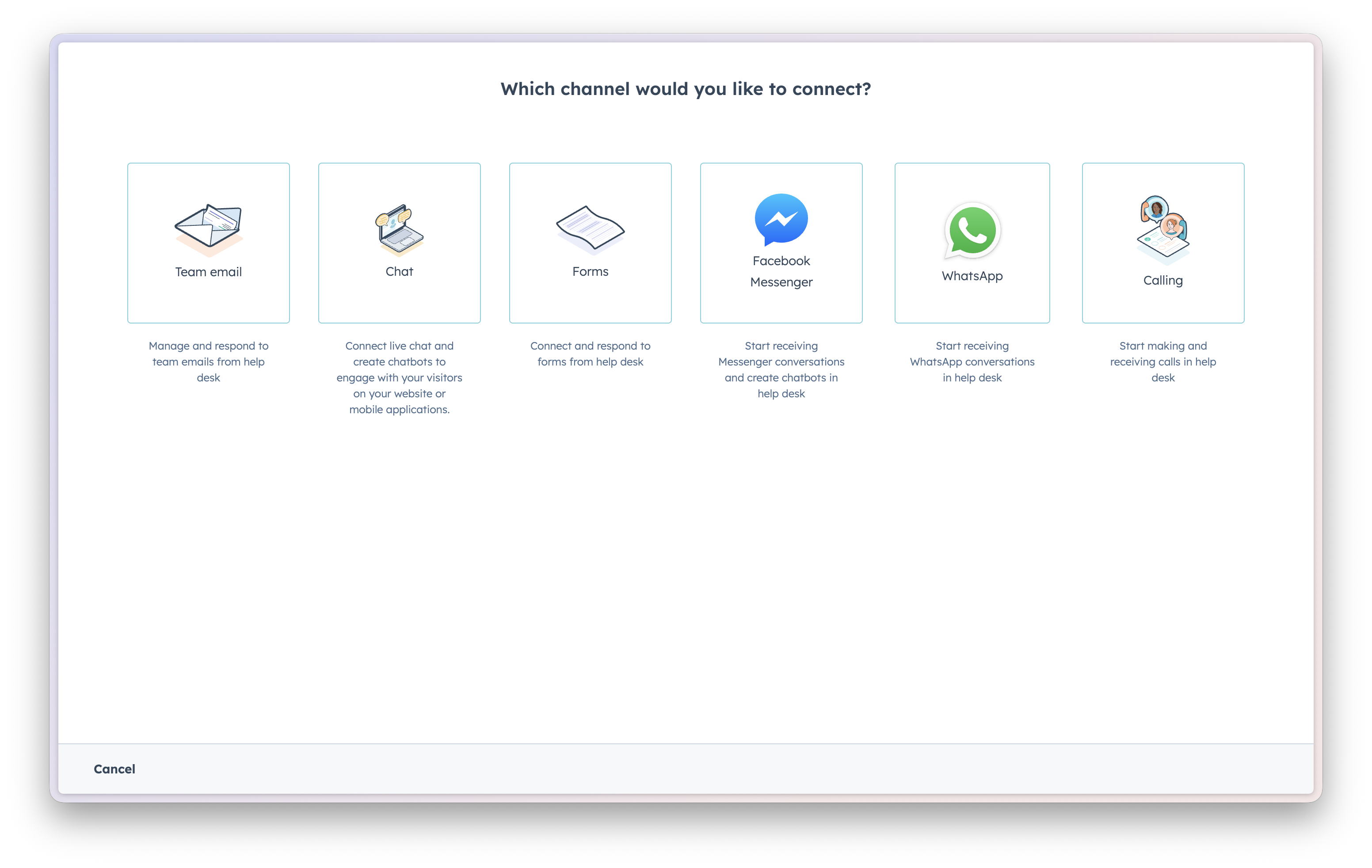
Context follows the conversation. Ownership is clear. Actions are visible.
This is where solutions like HubSpot Service Hub, and specifically the Help Desk, quietly play a critical role — not as a ticketing system, but as the operational surface where this unification becomes possible.
The technology matters, but only insofar as it enables teams to work from one screen, with one shared reality.
This is what we have been working on at Andimol during January. Helping companies to centralise their communications.
When AI Becomes Operational Instead of Experimental
Once communication is unified and traceable, artificial intelligence stops being a side experiment and starts delivering real value.
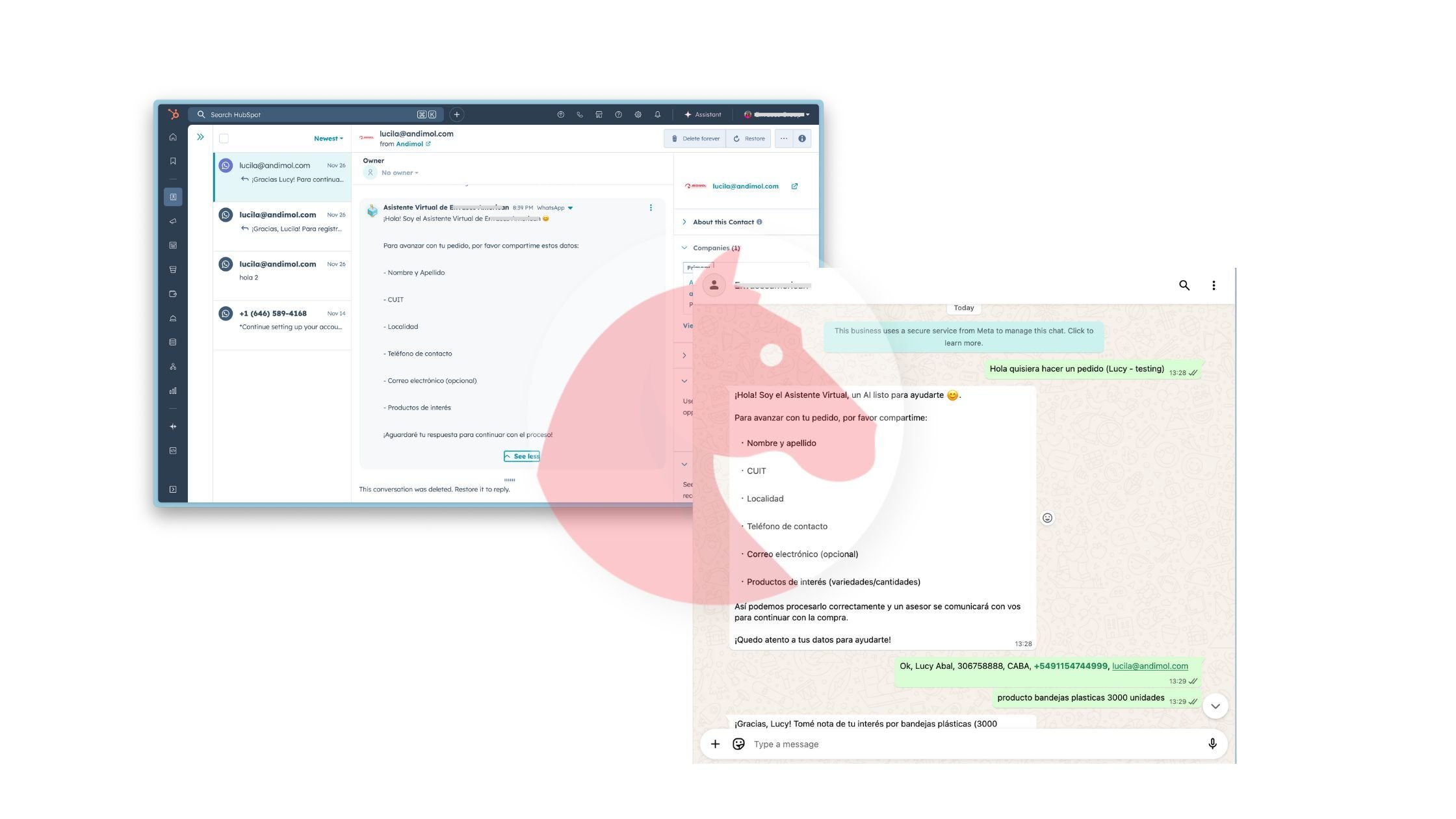
An embedded Customer Agent can assist teams by learning from historical conversations, suggesting replies, classifying intent, and supporting routing decisions. Importantly, it does this within the same communication layer, using the same customer context.
The value does not come from automation alone. It comes from relevance.
Because the agent operates inside a unified system, it understands where the customer is, what has already been discussed, and when a human should take over. It reduces cognitive load without removing accountability.
This is how AI supports scale without sacrificing quality.
Why This Matters Now
As businesses grow, communication complexity grows even faster. New channels are added. Teams specialize. Handoffs increase. At the same time, expectations rise — from customers, from internal teams, and from leadership.
Fragmented communication does not just slow organizations down. It undermines decision-making at its core.
Achieving 100% traceability of customer interactions is how companies protect institutional knowledge, improve collaboration, and make their CRM something teams actually trust and use.
Service Hub: The big misunderstood
Thinking about Service Hub for your business is not about deploying a help desk.
It is not about tickets.
It is not even about support.
It is about building a system where every customer interaction matters, because every interaction is visible, connected, and actionable.
Only when communication stops being fragmented does it become possible to truly see what is happening across the organization. Patterns emerge. Bottlenecks become visible. Ownership becomes clear.
This is the point at which teams can finally begin to measure.
Without traceability, concepts like response times, resolution times, or service levels remain theoretical. You cannot define SLAs when you don’t have a complete view of where conversations start, how they move, and where they stall. Any metric built on partial data is misleading at best.
Visibility comes first. Measurement follows.
And only then does improvement become possible.
When organizations achieve unified, traceable communication, they unlock the ability to set meaningful SLAs, not as arbitrary targets, but as informed commitments based on reality. From there, optimization becomes continuous rather than reactive.
This is how teams stop reacting to noise —
and start improving with intent.
If this resonates with your company, you can let us know. We can fix it, we can help your business regain the power of communication with your clients. Book a quick meeting here.
![[EN] CTA blog = servicios 10](https://no-cache.hubspot.com/cta/default/1231510/interactive-188339311931.png)